
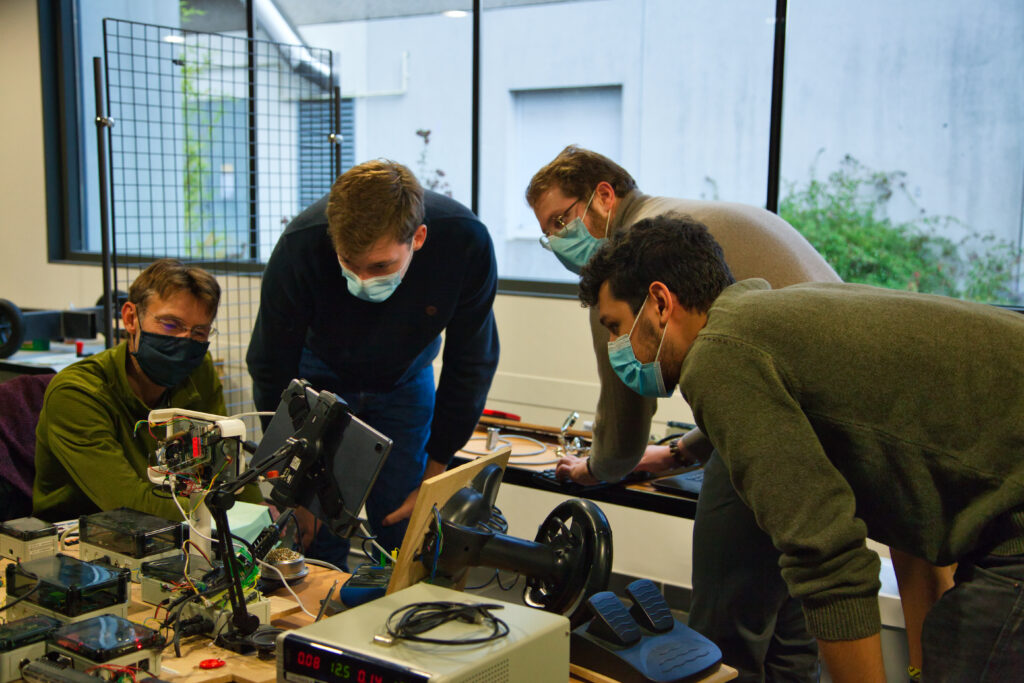
Future-IoT traditionally embeds a hackathon. You will work in teams of about 4 people. Your team will start working on one challenge from the beginning of August. After the distributed off-site preparation, you will have 24h (Wed-Fri) for working on-site with the others on your Proof-of-Concept. Friday you pitch your result in front of our expert jury, and the best project is selected.
For the moment we have the following challenges confirmed:
Siemens – Autonomous Guided Vehicles for the factory of the future
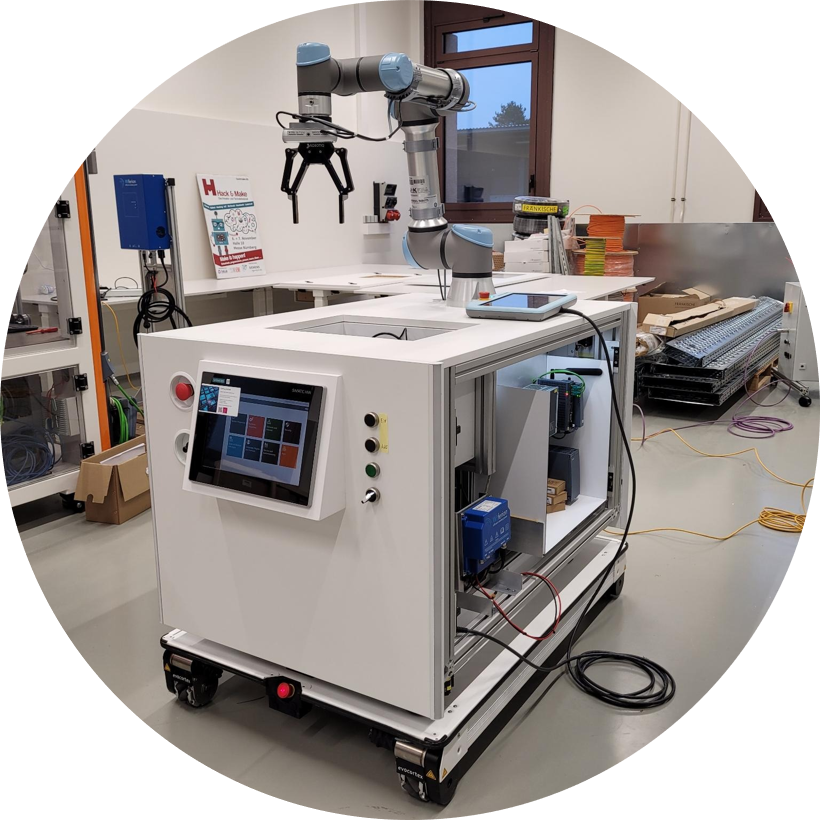
A helping Hand – Flexible grasping using AI. In the field of mobile robotics we want to extend the abilities of our machines with robot arms that we made more clever by using an existing framework. Each arm can become an AI king by adding a camera and practice grasping new objects by themselves. You can start building your idea on what a robot arm was always meant to do. Trust on this awesome AI-detection Algorithm and focus one your vision.
IMT/AWS – Automated Analysis and Synthesis of Multimedia Data
Used technology (proposal): video stream, voice recognition, image magick, twitter, youtube, facebook, linkedin, face recognition, python, shell, ffmpeg
Many data sources exist. FIOT events are also producing a lot of data. The goal of this challenge is making use of the stream data. Your task will be analyzing the data to identify iconic moments. To do so, the idea is to transcribe what is said and create images with text overlay for sharing on social media. AWS face recognition technology can help for identifying speakers, audience, the right part of the image etc.
A possible approach could be generating possible image text combination while allowing editing of the text for possible corrections. A human user could then select which ones to share and the system would take care of the distribution.
A first prototype you can use as a starting point for this challenge is already existing. We are looking forward to your creative approaches that you can test already during the event.
IMT – Autonomous Machine-to-Human Signaling via Integration of low-cost IoT Hardware via Bluetooth and Infrared
Used Technologies (proposal): Bluetooth, Infrared, WiFi, MQTT, proprietary protocols, Raspberry Pi, shell, python
A key principle of the IoT are mash-ups: entities that are meant to be connected (or not) get connected. In this challenge we want to explore how off-the-shelf devices with different communication technologies can be connected to a system.

Goal of the project: Create software for the raspberry pi that can communicate via bluetooth with the above lights and via infrared with a programmable alarm clock. At the beginning of a talk, the clock should send the remaining time to the alarm clock countdown and start it. The volume meters can be configured via bluetooth. They should be integrated in a way that they change color throughout the talk depending on the remaining time, e.g. turning more red towards the end.. This way the speaker and the audience know how much time is left.
There is already some preparatory work done regarding the hardware and software. The clock is already controllable via an MQTT to infrared gateway. For the bluetooth you will have to revers engineer the protocol, e.g. by reading the commands sent by the according app. You will have time to develop additional cool features to the described ones. We are looking forward to seeing your ideas implemented!
If you see use for addition al technology such as face recognition with AWS etc. you will have the experts on site.
FUB / ECDF – IoT Fleet Management
Motivation
Security and management of low power IoT networks at large scale poses multiple challenges.
Whereas single devices can be configured manually one by one, scaling up requires new layers of abstraction to conveniently orchestrate and autoconfigure fleet of devices.
Challenges
The challenge focuses primarily on drafting an architecture for managing a fleet of low-power networked IoT devices, building atop open communication standards as much as possible.
The targeted devices are all low-power devices (microcontrollers such as described below) that have limited network capabilities and resources.
The provided architecture would allow for:
Monitoring the network and the devices.
Configuration of multiple and individual devices.
Collaborative measurements and actuation between devices.
Spreading software/firmware updates throughout the network.
Autonomous/automatic reconfiguration of the fleet to match high-level requirements
Expected outcome
A drafted architecture of the software around the challenge (slideware).
The architecture must include some form of orchestration, allowing for configuration and remote updating of the devices.
Ideally, a small Proof of Concept setup using real IoT hardware connecting server-side and device-side software is within scope, but optional due to time limitation of the challenge.
Starting Point / Building Blocks
For hands-on aspects we’d provide multiple IoT low-power boards (nRF52840dk boards + sensors). A code base using RIOT would be provided to run a small demo network on them with each device running a small CoAP server and a registry to communicate with them. This would provide a starting point for the participants for a demonstrator of their architecture.
Prerequisite skills
Knowledge of computer networks
Knowledge of embedded systems with microcontrollers such as the Arduino
Experience with programming languages such as C, Python, Go
Not required, but bonus
Experience with embedded operating systems such as RIOT, Zephyr or FreeRTOS
Experience with constrained protocols and data formats such as CoAP and CBOR
Acklio/AWS – Integration of an Acklio LoraWAN Gateway with the AWS Smart Territory Framework
Used technology: Lora, AWS
This challenge is about integrating an Acklio LoraWAN gateway into the cloud, more particular into the AWS Smart Territory Framework.